Publicações 2026
Sea turtles, Lepidochelys olivacea, Eretmochelys imbricata, Southwestern Atlantic, Eastern Pacific, Hg, Amazon soils, Gross primaryproductivity, Height above nearest drainage, Soil organic matter, Geostatistical analysis, Remote sensing, MeHg in the plankton, MeHg in zooplankton, MeHg to seasonal hydrological changes, Brazilian Amazon, Madeira River, Cerrado, Floodplain lakes, Rodents, Marsupials, Amazon; Amazon Dark Earths; forest, Geochemistry, Total mercury, risks in Amazon, Cerrado floodplain lakes
ARTIGOS & PERIÓDICOS
Abstract:
We evaluated total mercury (THg) concentrations in fish from lakes in two major South American river basins: the Madeira River basin in the Western Amazon, impacted by gold mining, deforestation, and wildfires; and the Araguaia River basin in the Brazilian Savanna (Cerrado), where deforestation and wildfires are the main anthropogenic pressures. Total Hg concentrations ranged from 37 to 2473 µg kg⁻¹ in Puruzinho Lake (Madeira River basin) and from 6 to 1947 µg kg⁻¹ in floodplain lakes of the Araguaia River basin. Comparisons between river basins revealed significantly higher THg concentrations in the Madeira River basin for detritivorous, carnivorous, and piscivorous fish, whereas no significant difference was observed for planktivorous species. Within both basins, THg concentrations in planktivorous, carnivorous and piscivorous fish were significantly higher than those observed in detritivores. The trophic magnification slope further confirmed Hg biomagnification along the food web, with a higher coefficient of determination in the Araguaia River basin. Estimated weekly intake calculations indicated substantially greater dietary Hg exposure in the Madeira basin under moderate to high fish consumption scenarios, particularly for predatory species. Although Hg concentrations and the associated risks from fish consumption are higher in the Madeira River basin, which has a long history of gold mining, our results highlight land-use change as an important driver of Hg bioaccumulation in fish across Neotropical ecosystems.
Contrasting anthropogenic drivers of mercury bioaccumulation in fish and associated dietary exposure risks in Amazon and Cerrado floodplain lakes
Lucas Cabrera Monteiro · Ludgero Cardoso Galli Vieira · José Vicente Elias Bernardi · Ronaldo de Almeida · Cássio da Silva Cabral · Fabrício Barreto Teresa · João Carlos Nabout · Wanderley Rodrigues Bastos
Abstract:
Amazonian Dark Earths (ADEs), despite being a relatively minor part of Amazonian soils, are traditional choices for agricultural production by local people, which increases the potential for remobilization of Hg from these soils to aquatic environments. Therefore, considering the relevance of Hg and the general use of ADEs in the Amazon, this study aimed to evaluate the vertical distribution and the edaphic factors controlling total mercury in Amazonian Dark Earth profiles from the Madeira and Solimões River Basins to infer the relative potential for Hg retention or mobilization compared to other Amazonian soils. This study comprises ADEs sampled from the Madeira River (n = 34) and Solimões River Basins (n = 43), with depth varying between 0.20 and 0.90 m. The contents of the elements (Ca, Mg, Co, Cr, Fe, K, Mn, Ni, P, Ti, V, Zn and Zr) were determined by induced plasma optical atomic emission spectrometry. Total Hg was determined by atomic absorption spectrophotometry (AAS) with cold-vapor generation (CV-AAS). Soil classification was carried out according to the Brazilian Soil Classification System. The data show there are at least four interrelated components for Hg dynamics in ADEs: lithogenic control is indicated by immobile elements, pedogenic control by the association of Hg with iron associated with human control responsible for the deposition of ash and organic matter in soils over thousands of years, and hydromorphic control in poorly drained soils or those located in areas of periodic flooding.
Biogeochemistry of mercury in Amazonian Dark Earths (ADEs) of the Brazilian Amazon
Ronaldo de Almeida , José Furtado de Miranda , Carlos Ernesto Gonçalves Reynaud Schaefer , Hedinaldo Narciso Lima , Izidro Ferreira de Sousa Filho , Luiz Drude de Lacerda , Wanderley Rodrigues Bastos
Abstract:
We evaluated total mercury (THg) concentrations in fish from lakes in two major South American river basins: the Madeira River basin in the Western Amazon, impacted by gold mining, deforestation, and wildfires; and the Araguaia River basin in the Brazilian Savanna (Cerrado), where deforestation and wildfires are the main anthropogenic pressures. Total Hg concentrations ranged from 37 to 2473 µg kg⁻¹ in Puruzinho Lake (Madeira River basin) and from 6 to 1947 µg kg⁻¹ in floodplain lakes of the Araguaia River basin. Comparisons between river basins revealed significantly higher THg concentrations in the Madeira River basin for detritivorous, carnivorous, and piscivorous fish, whereas no significant difference was observed for planktivorous species. Within both basins, THg concentrations in planktivorous, carnivorous and piscivorous fish were significantly higher than those observed in detritivores. The trophic magnification slope further confirmed Hg biomagnification along the food web, with a higher coefficient of determination in the Araguaia River basin. Estimated weekly intake calculations indicated substantially greater dietary Hg exposure in the Madeira basin under moderate to high fish consumption scenarios, particularly for predatory species. Although Hg concentrations and the associated risks from fish consumption are higher in the Madeira River basin, which has a long history of gold mining, our results highlight land-use change as an important driver of Hg bioaccumulation in fish across Neotropical ecosystems.
Contrasting anthropogenic drivers of mercury bioaccumulation in fish and associated dietary exposure risks in Amazon and Cerrado floodplain lakes
Lucas Cabrera Monteiro, Ludgero Cardoso Galli Vieira, José Vicente Elias Bernardi, Ronaldo de Almeida, Cássio da Silva Cabral, Fabrício Barreto Teresa, João Carlos Nabout and Wanderley Rodrigues Bastos
Abstract:
The Lower Madeira River (Western Amazon) is a hotspot for mercury (Hg) contamination due to both natural geochemical enrichment and long-term anthropogenic activities. Total mercury (THg) concentrations were significantly higher in marsupials (median = 0.136 mg kg⁻¹) than in rodents (median = 0.032 mg kg⁻¹, p = 0.0006). Arboreal rodents showed lower Hg levels than omnivorous rodents. Terrestrial rodents showed higher Hg concentrations than arboreal rodents (p < 0.00010). Age did not influence Hg levels in the studied orders. The marsupial species Marmosops sp. (3.379 mg kg⁻¹) and Marmosa murina (2.571 mg kg⁻¹) showed the highest Hg concentrations, while in the rodent Sphiggurus roosmalenorum (n = 4), the concentrations remained below the detection limit. Atmospheric deposition is likely a source of Hg for herbivores, in addition to insects to supplement the diet. For omnivores, the main source of Hg is insects, which transport the element from the aquatic environment to the terrestrial environment.
Non-invasive assessment of mercury exposure in rodents and marsupials from a historically contaminated area of the Madeira River, Western Amazon
João Bezerra Facundo, Cássio da Silva Cabral, Mariluce Resende Messias, Wanderley Rodrigues Bastos & Wilson Gomez Manrique
Abstract:
Riverine populations in the Brazilian Amazon are chronically exposed to mercury (Hg), primarily through fish consumption. This study assessed temporal trends, sociodemographic determinants, and health risks associated with Hg exposure in three riverside communities (Nazaré, Calama, and São Carlos) in the Madeira River basin (Western Amazon). Total mercury (THg) was quantified in hair samples from 618 adults collected in 2022 and compared with data obtained two decades earlier by our research group. Mean THg concentration was 7.82 ± 8.18 mg kg⁻¹, with 90% of individuals exceeding the U.S. EPA safety threshold and 76% surpassing the FAO/WHO guideline. A significant temporal decline was observed only in Nazaré, but exposure levels remained persistently above international health thresholds in all communities. Lower educational attainment and exclusive fish consumption were consistently associated with higher THg concentrations. Age and length of residence further influenced exposure patterns in specific communities. Risk assessment based on the most frequently consumed fish species showed estimated weekly intakes exceeding the provisional tolerable weekly intake for nearly all trophic groups, particularly omnivorous and piscivorous species. Hazard quotient values were significantly greater than 1, suggesting potential non-carcinogenic health risks. Although herbivorous species presented comparatively lower exposure risks, current consumption rates still exceed safe limits. Our findings demonstrate that biomagnification within aquatic food webs, combined with socioeconomic vulnerability and dietary dependence on fish, sustains elevated Hg exposure despite reductions in regional gold mining. These results underscore the urgent need for culturally appropriate public health interventions that promote safer fish consumption patterns while preserving the nutritional importance of fisheries for Amazonian riverine populations.


Graphical Abstract:
Temporal changes and sociodemographic determinants of mercury exposure in Madeira River communities, Brazilian Amazon
Fábio Ximenes da Silva, Lucas Cabrera Monteiro, Cássio da Silva Cabral, Thayson Araujo Canela, José Vicente Elias Bernardi, Ronaldo de Almeida, Wanderley Rodrigues Bastos
Abstract:
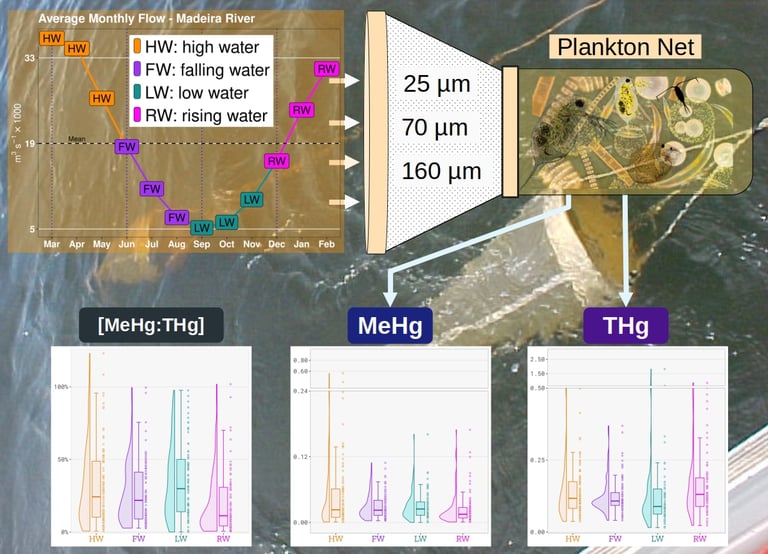
Mercury (Hg) contamination is a serious environmental problem due to its toxicity and bioaccumulation in aquatic communities. In the Amazon, hydrological fluctuations influence plankton structure and abundance, while gold mining constitutes an important anthropogenic source of Hg, releasing the metal into the water column and facilitating its incorporation by biota. In this study, we assessed total Hg (THg), methylmercury (MeHg), and the MeHg:THg ratio in the planktonic community of the upper Madeira River basin (Brazil) over a 10-year period. Mean concentrations of THg, MeHg, and MeHg:THg were 0.144 ± 0.138 mg kg⁻¹, 0.035 ± 0.049 mg kg⁻¹, and 0.283 ± 0.245, respectively. THg concentrations were higher during the rising-water period, particularly in larger zooplankton, reflecting seasonal hydrological inputs and changes in plankton composition. MeHg concentrations in total plankton were lower during the rising-water period, likely due to dilution effects and reduced bioavailability. When stratified by mesh size, MeHg concentrations were primarily determined by organism size, with larger zooplankton exhibiting higher levels than phytoplankton. The highest MeHg:THg ratios in total plankton and zooplankton were observed during low-water periods, likely driven by lower THg concentrations rather than by increased MeHg production alone. Across all seasons, larger zooplankton consistently exhibited higher MeHg:THg ratios than phytoplankton, indicating size-dependent bioaccumulation patterns. Our results demonstrate that Hg dynamics in plankton are strongly modulated by the hydrological cycle and exacerbated by anthropogenic inputs, emphasizing the importance of long-term monitoring to assess ecological risks in tropical river systems.
Graphical Abstract:
Effect of seasonality and organism size on mercury (MeHg) bioaccumulation in plankton of the Madeira River Basin, Western Amazon
Iuri Aparecida da Silva Oliveira, Lucas Cabrera Monteiro, Izidro Ferreira de Sousa-Filho, Elisabete Lourdes do Nascimento, Ronaldo de Almeida, Cássio da Silva Cabral, Wanderley Rodrigues Bastos
Abstract:
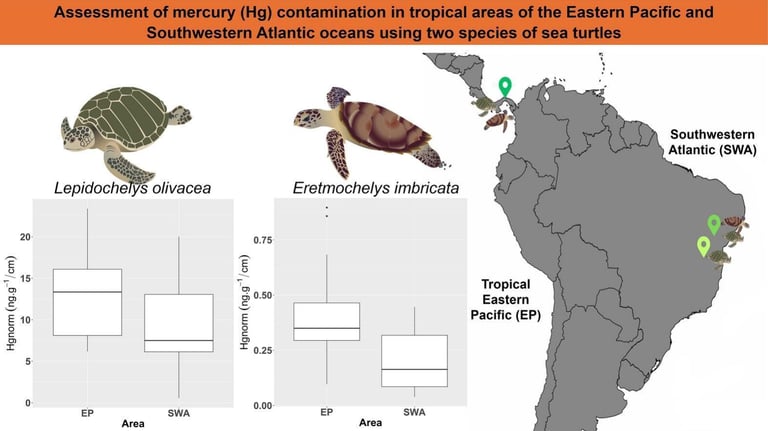
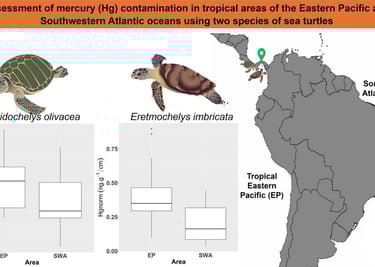
Mercury (Hg) emissions from both natural and anthropogenic sources influence Hg levels in the biota of a given region. Tropical regions, such as those in the Southwestern Atlantic (SWA) and the Eastern Pacific (EP) are particularly interesting due to differences in natural Hg sources, which may impact Hg levels in marine organisms, including sea turtles. In the EP, the Circum-Pacific Belt is a significant natural source of Hg, while natural Hg sources in the SWA are negligible. Moreover, anthropogenic sources are similar in both regions. We analyzed Hg concentrations and stable isotopes (δ13C and δ15N) in scutes, a non-invasive sampling procedure, of two populations of sea turtle's (Lepidochelys olivacea and Eretmochelys imbricata), found on the Pacific coast of Panama and the Northeastern coast of Brazil. The main objective of this study was to compare Hg concentrations between these populations and relate them to the environmental characteristics and feeding behaviors. The results revealed significantly higher Hg concentrations in L. olivacea and E. imbricata from the EP compared to those from the SWA, likely linked to higher environmental Hg levels from natural sources, as well as dietary habits, which were observed through the analysis of their trophic niches. Additionally, the results confirm the effectiveness of sea turtles' scutes as an interoceanic monitoring tool.
Graphical Abstract:
Assessment of mercury (Hg) contamination in tropical areas of the Eastern Pacific and Southwestern Atlantic oceans using two species of sea turtles
César Augusto Barrios-Rodriguez, Moisés F. Bezerra, Eric Enrique Flores, Carlos Antonio Vigil-González, Wilfredo Poveda-Pineda, Joelbin de la Cruz, Carlos Eduardo de Rezende, Marcelo Gomes de Almeida, Wanderley Rodrigues Bastos, Luiz Drude de Lacerda
Linking remote sensing and soil properties to model mercury spatial patterns in a natural reserve in the Amazon rainforest
Ygor Oliveira Sarmento Rodrigues, Lucas Cabrera Monteiro, Ronaldo de Almeida, Ângelo Gilberto Manzatto, Wanderley Rodrigues Bastos, Carlos Tadeu Carvalho do Nascimento & José Vicente Elias Bernardi
Abstract:
Mercury (Hg) accumulation in Amazonian soils is influenced (governed) by atmospheric deposition, hydrological processes, and the rapid turnover of organic matter. Understanding its spatial distribution is critical for assessing ecosystem vulnerability and informing conservation strategies in tropical forests. We collected thirty surface soil samples within a 5 × 5 km grid in a protected area of the Amazon rainforest to investigate spatial relationships of total mercury (THg) concentrations. Variogram analysis and geostatistical interpolation—Ordinary Kriging (OK) and Co-Kriging (CK)—were applied to characterize spatial autocorrelation. Remotely sensed variables, including Gross Primary Productivity (GPP) and Height Above Nearest Drainage (HAND), were integrated alongside soil classification and soil organic matter (SOM) to improve predictive accuracy. THg concentrations, determined by cold vapor generation atomic absorption spectrophotometry, averaged 60.51 ± 18.16 μg kg⁻¹, with Oxisols and Ultisols showing comparable means (~ 62 μg kg⁻¹). CK models incorporating GPP and HAND achieved the lowest mean absolute error (MAE = 0.027), with similar spatial ranges for THg, GPP, and HAND supporting their joint predictive capability. GPP alone was a significant predictor (MAE = 0.04), consistent with links to atmospheric Hg deposition, terrain morphology, and sediment redistribution. Spatial patterns revealed Hg hotspots in intermediate topographic zones where organic and inorganic leaching (podzolization) and high humic activity occur, while Hg losses were associated with transport from upland plateaus and seasonally flooded areas. These results demonstrate that coupling geostatistical modeling with remote sensing products provides a robust approach for predicting Hg distribution in Amazonian soils and can inform environmental monitoring and management efforts in sensitive tropical ecosystems.



Rodovia BR-364 km 9,5 sentido Acre. Bloco 1Q, Campus José Ribeiro Filho.
Porto Velho - Rondônia. CEP: 76800-500




+55 69 99239 4177
Copyrights © BioGeoQuímica Ambiental 2026


Buscamos capacitar a geração de amanhã para um futuro melhor e esperança para cada indivíduo.
+55 69 99969 3084
Coordenador: Dr. Ronaldo de Almeida
Vice-Coordenador: Dr. Wanderley Bastos